Boost Profits with Plumbing Software 2026
Plumbing Software, Scheduling Tools, Business Efficiency, Cost Savings
Plumbing Software 2026: Why Static Calendars Are Costing You $50k/Year
If your plumbing business is still run from a whiteboard, paper diary, or a basic Google Calendar, you are almost certainly leaving tens of thousands of dollars on the table every year. In 2026, modern plumbing software and intelligent scheduling tools have turned the calendar into a profit engine—while static calendars quietly drain cash, time, and customer trust.
Static Calendars vs. Smart Plumbing Software: What’s the Real Difference?
At a glance, a static calendar looks harmless. Jobs are written in, technicians are assigned, and the day marches on. But a static calendar—whether it’s a wall planner, spreadsheet, or basic digital calendar—doesn’t think. It doesn’t react to last‑minute cancellations, traffic, technician skills, or high‑value opportunities. It simply records what you tell it.
Modern plumbing software, by contrast, is built to manage the entire lifecycle of a job: lead capture, estimating, scheduling, dispatch, invoicing, and follow‑up. Platforms like QuoteIQ, Jobber, Housecall Pro, and ServiceTitan combine scheduling tools with CRM, pricebooks, inventory, and payments in a single system (myquoteiq.com; build-folio.com). The calendar is just one visible layer of a much smarter engine underneath.
How Static Calendars Quietly Bleed $50k/Year from Your Business
The $50,000 figure is not an exaggeration for a typical small to mid‑size plumbing company. When you add up lost jobs, wasted drive time, admin overhead, and slower invoicing, static calendars become one of the most expensive “free” tools in your business. Here’s where the money leaks out.
1. Missed and Mishandled Calls
With a static calendar, every new booking depends on a human being available to answer the phone, check availability, and manually slot in a job. During busy seasons, that often means calls are missed or customers are put on hold while staff shuffle appointments. Tools like QuoteIQ, FieldServicePro, and SchedulingKit offer online booking, customer portals, and even AI‑assisted scheduling that can capture jobs 24/7 (fieldservicepro.io; schedulingkit.com).
If your average job is worth $450 and you lose just 10–12 calls a month because no one could “get to the calendar in time,” that’s $54,000–$64,800 in annual revenue slipping away. Smart plumbing software turns those missed opportunities into booked jobs automatically.
2. Inefficient Routing and Technician Utilization
Static calendars don’t understand geography, traffic, or technician skill sets. It’s easy to end up with one tech crisscrossing town while another is under‑utilized. Modern scheduling tools in platforms like Jobber, Workiz, and FieldEdge provide route optimization, GPS tracking, and skill‑based assignment (myquoteiq.com).
Cutting just 30 minutes of wasted drive time per tech per day across a 5‑truck operation equates to over 600 reclaimed billable hours a year. At $120/hour, that’s $72,000 in potential revenue capacity—more than enough to pay for best‑in‑class plumbing software and then some.
3. Slow Estimating and Invoicing Cycles
On a static calendar, a job is “done” when it’s crossed off. But the money only hits your account when the estimate is approved and the invoice is paid. Modern plumbing software connects your scheduling tools directly to estimating and billing. QuoteIQ, for instance, offers AI‑powered estimating, digital pricebooks, and instant invoicing from the field (myquoteiq.com).
Faster estimating doesn’t just save admin time; it wins more jobs. For commercial contractors producing hundreds of bids a year, cutting quote time in half can save six figures in estimator labor alone (workflowunity.io). Even in residential, being the first polished quote in a customer’s inbox can be the difference between winning and losing thousands in potential revenue.
2026 Technology: What Today’s Scheduling Tools Actually Do Differently
The leap from static calendars to 2026 plumbing software isn’t just about going “digital.” It’s about putting intelligent automation and real‑time data behind every booking. Here are key advances that matter for plumbing businesses and agencies managing multiple crews or locations.
AI‑assisted scheduling and dispatch: Platforms like Fieldproxy and Workiz use AI to prioritize emergency jobs, match the right technician, and fill schedule gaps automatically (fieldproxy.ai).
Customer self‑service booking: Tools such as QuoteIQ InstaSchedule and SchedulingKit let customers request time slots online, while the system auto‑checks technician availability and zones.
Integrated inventory and pricebooks: With platforms like QuoteIQ and FieldEdge, your scheduling tools know which parts are in stock and what they cost, so technicians can quote accurately on site (myquoteiq.com).
Real‑time communication: Automated text reminders, “on the way” notifications, and pay‑by‑text links reduce no‑shows and speed up cash flow—features common in Housecall Pro and ServiceTitan.
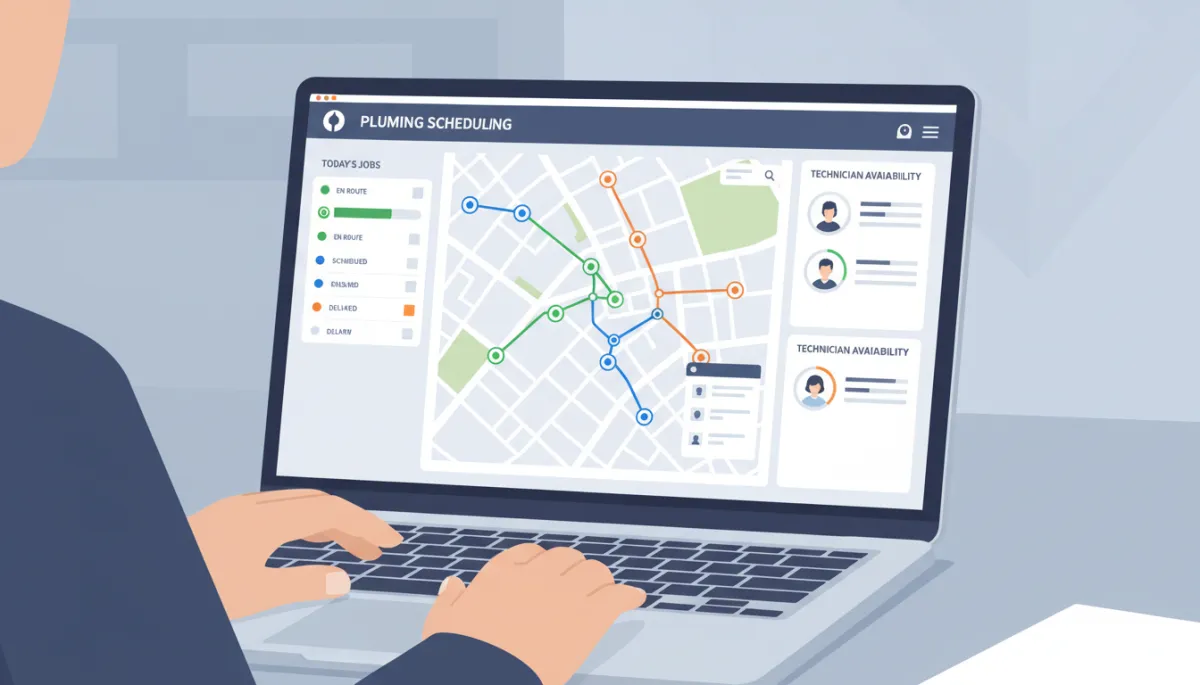
Intelligent dispatch dashboards turn raw calendars into live, profit-focused control centers.
Counting the Cost: Why “Free” Static Calendars Lose to Modern Plumbing Software
Many owners hesitate to invest in plumbing software because they’re already paying for generic tools—or because a whiteboard technically costs nothing. But when you compare total cost of ownership to the gains in business efficiency, the math is clear.
Software Costs vs. Fragmented Tool Stacks
Research shows that juggling multiple disconnected tools for scheduling, CRM, invoicing, and dispatch can cost small operations $237–$572 per month in subscriptions and wasted time. Unified platforms can cut that to roughly $60–$130 per month (quantrahq.com). In other words, you may already be paying more for a messy tech stack than for a single, robust plumbing platform.
For example, QuoteIQ starts at $29.99/month and can replace four to five separate tools with dispatch, AI estimating, InstaQuote, invoicing, and CRM in one app (myquoteiq.com). Even premium solutions like ServiceTitan, at roughly $245–$500 per tech per month, often pay for themselves through 15–25% higher average tickets and tighter operations (tooleduppro.com).
Time Is Your Most Expensive Line Item
Consider your dispatcher or office manager. If they spend an extra 1–2 hours a day manually updating a static calendar, chasing technicians for status updates, and calling customers about changes, that’s 250–500 hours a year of low‑value admin work. At even $25/hour, you’re burning $6,250–$12,500 annually—purely because your scheduling tools can’t keep up.
Add in technician idle time, missed jobs, and slower invoicing, and it’s easy to see how the true cost of static calendars climbs toward—or beyond—the $50,000 mark for many plumbing businesses.
Matching Plumbing Software to Your Business Size and Model
Not every operation needs an enterprise‑grade platform, but every serious operation needs more than a static calendar. The good news: 2026 offers strong options at every level.
Solo to small teams (1–10 techs): Tools like QuoteIQ Essentials and Jobber deliver powerful scheduling tools, quoting, and invoicing starting around $30–$40/month—ideal for replacing a whiteboard without overwhelming your crew (build-folio.com).
Growing residential teams (5–25 techs):Housecall Pro, Workiz, and FieldServicePro shine for call volume, customer communication, and AI‑assisted scheduling, typically in the $189–$225/month range.
Mid‑market and commercial operations: Combining robust field service tools with advanced estimating (like BuildVision AI) or even exploring custom platforms can deliver major cost savings and efficiency gains over cobbled‑together SaaS stacks (workflowunity.io).
Enterprise (20+ techs):ServiceTitan and similar systems provide deep dispatch, membership, marketing, and financial tools that can justify their higher per‑tech pricing when deployed well.
💡 Pro Tip: As a rule of thumb, investing just 1–3% of revenue in the right plumbing software can unlock far greater gains in business efficiency, average ticket size, and cost savings over three years.
Turning Your Calendar into a Competitive Advantage in 2026
Static calendars made sense when most work came from word‑of‑mouth, phones rang only during business hours, and customers were content to “wait for a call back.” That world is gone. In 2026, homeowners expect instant confirmations, live ETAs, and digital payments. Commercial clients expect rapid, accurate estimates and clear documentation. Your scheduling tools are now part of your brand.
By upgrading to modern plumbing software, you’re not just swapping a calendar app—you’re redesigning how work flows through your business. Jobs are captured automatically, routed intelligently, completed efficiently, and billed instantly. Office staff spend less time firefighting and more time growing relationships. Technicians spend more time on profitable work and less time in traffic. Customers feel informed, respected, and eager to refer you.
The question for plumbing businesses and agencies in 2026 isn’t whether you can afford plumbing software. It’s whether you can afford to keep running on static calendars that quietly cost you $50,000 a year in lost revenue and wasted effort. The tools to reclaim that money—and turn your calendar into a true profit center—are already here. The next move is yours.
